


How to Use Local Lead Gen Data to Evaluate National Brand Campaigns
As a PPC manager or marketing leader for a franchise brand, you’re constantly juggling two worlds: the grand vision of national branding and the gritty reality of local lead generation for franchisees. National branding campaigns—whether they’re high-budget TV spots, splashy digital ads, or major sponsorships—are designed to build awareness and affinity across the brand’s entire territory. But how do you know if that expensive brand awareness is actually paying off where it counts: at the local franchisee level?
The answer might be hiding in plain sight, right inside your local campaign data.
The thesis is simple: When a national brand is strong and well-advertised, it should act as a rising tide that lifts all boats. A powerful brand doesn’t just make people “aware” of your company; it primes them to take action. Therefore, if your national branding is effective, you should see a direct, measurable improvement in the performance of your local lead generation campaigns.
By aggregating key metrics like Cost Per Lead (CPL) and Click-Through Rate (CTR) across your network of 20, 50, 100, or 500 locations, you can turn local performance data into a powerful barometer for national brand health.
The “Brand Halo” Effect in Action
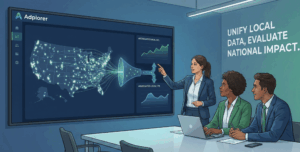
Let’s illustrate this with a home services example. Imagine you’re the CMO for a national plumbing franchise, “ProFlow Plumbers.” You’ve just launched a major, multi-million dollar national TV and digital campaign featuring a memorable jingle and a celebrity spokesperson.
Scenario A: The Campaign is a Success
- National Level: Viewership is high, social media sentiment is positive.
- Local Level: A homeowner in suburban Chicago has a leaky faucet. They go to Google and search for “plumber near me.” They see three ads. One is for “Bob’s Plumbing,” another for a local chain, and the third is for the local “ProFlow Plumbers” franchisee. Because the national campaign has successfully established ProFlow as a trusted, professional, and familiar name, the homeowner is more likely to click on the ProFlow ad.
- Data Impact: Across hundreds of locations, you see the aggregated CTR for local PPC ads increase. Because more people who see the ad are clicking it, your Quality Scores improve, and your cost per click drops. More importantly, because these clicks are coming from people already primed to trust the brand, they convert into leads at a higher rate. The result? A noticeable decrease in aggregated CPL.
Scenario B: The Campaign Falls Flat
- National Level: The ads are forgettable, or worse, annoying.
- Local Level: The same homeowner searches for a plumber. They see the ProFlow ad but scroll right past it to click on a competitor with better reviews or a more compelling local offer. The expensive national branding didn’t create a preference.
- Data Impact: Your aggregated local CTR remains stagnant or even declines. You’re paying for impressions that don’t turn into clicks. Consequently, your CPL remains high or increases as you fight harder for every lead.
How to Execute This Evaluation Strategy
You don’t need expensive brand lift studies or focus groups to see if your national spend is working. You already have the data. Here’s a practical framework for PPC managers:
- Establish Your Baseline: Before a major national campaign launches, calculate the historical average CTR and CPL across all your locations for a set period (e.g., the previous quarter or year-over-year). This is your “pre-campaign” benchmark.
- Define the Campaign Window: Clearly identify the start and end dates of your national branding push.
- Monitor and Aggregate: As the national campaign runs, continuously aggregate performance data from all local campaigns. Group the data by region or market size if you want to see if the campaign resonates differently in different areas.
- Analyze the Delta: Compare the aggregated CTR and CPL from the campaign window against your baseline.
- A significant decrease in CPL and increase in CTR is a strong signal that your national branding is successfully lowering the barrier to entry for local customers. It’s lubricating the sales funnel.
- No change or a negative change suggests the national messaging isn’t connecting or isn’t strong enough to influence local buying behavior. This is actionable intelligence you can take back to the branding team to refine the message or media mix.
The Power of Aggregation
The key here is volume. Data from a single franchisee can be noisy, influenced by local competition, a poor-performing website, or seasonal shifts. But when you aggregate data across 100 or 500 locations, those anomalies smooth out, revealing the true, underlying trend of brand strength. You’re not looking at a single data point; you’re listening to the collective voice of thousands of local customers responding to your brand.
Unlock the Full Potential of Your Data with Adplorer
Executing this strategy requires the right tools. You need a platform that can seamlessly pull together standardized data from hundreds of disparate local ad accounts—Google Ads, Meta, etc.—into one centralized view.
This is where Adplorer comes in. Our platform is built specifically for the unique challenges of franchise marketing. Adplorer allows you to manage, scale, and report on local campaigns across thousands of locations from a single dashboard. With our robust reporting capabilities, aggregating CPL and CTR data across your entire network is just a few clicks away, giving you the insights you need to bridge the gap between national branding and local results.
Stop guessing about the impact of your national spend. Start using the data you already have to prove its value.