




A Preview Guide to ChatGPT Ads for Franchise Brand and Agencies Serving Multi-Location Advertisers
The ppc and larger digital advertising space is shifting once again, and OpenAI’s ChatGPT Ads Manager has officially entered the chat. As conversational AI continues to dominate user behavior, the ability to place native advertisements directly within AI chat streams offers an entirely new potential way to capture intent, or does it?.
So, how exactly does it work, and what does it mean for multi-location businesses and franchise brands?
Based on an analysis of the platform’s core infrastructure per Adplorer’s testing, in this article we break down the instructions, core features, and structural insights you need to deploy campaigns effectively.
1. Account Set Up
To set up a ChatGPT Ads Manager account, you must first log in using an OpenAI account at ads.openai.com and complete a primary business profile, which includes providing your legal business name, website URL, industry type, and a square brand logo image. Next, you must define permanent account parameters—such as Country, Time Zone, Currency, and Advertiser Type—which cannot be changed after submission. Because agency accounts are not currently available, each individual advertiser must complete a formal identity verification process through a system named Persona by submitting their Employer Identification Number (EIN), business address, and legal registration documents. Finally, you must navigate to the billing overview dashboard to establish a live payment profile by providing an invoice routing email address, complete credit card information, and an authenticated corporate billing address before your ads can begin serving.
2. Currently Available Campaign Types (As of 6/15/26)
The ChatGPT Ads Manager currently offers two primary campaign objectives tailored to different stages of your marketing funnel:
- Clicks Campaigns: Designed to drive traffic directly to a specified URL. This uses a Maximum CPC (Cost-Per-Click) bidding model, where advertisers are billed strictly when a user actively interacts with the ad card.
- Reach Campaigns: Geared toward brand awareness and maximum visibility. This campaign type operates on a Maximum CPM (Cost-Per-Thousand Impressions) bidding model, allowing advertisers to bid on how much they’re willing to pay per 1,000 native impressions within the chat stream.
- Product Feed Campaigns: Built for seamless e-commerce scale, these allow merchants to link their real-time store inventory via a structured file upload (like XML or CSV). The AI then dynamically generates ad cards with the exact product image, description, and pricing to perfectly match a user’s conversational intent.cing to perfectly match a user’s conversational intent.
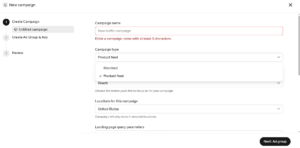
- Conversions: This campaign type as of the time of writing is not yet available. However conversion set up is available via pixel and so we can see what types of conversion events will be supported once conversion based campaigns are available.
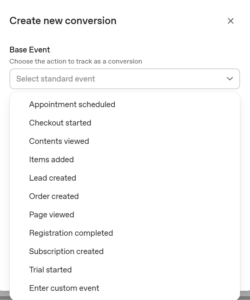
The conversion window is fixed at a pre-set 30 day window but it’s indicated that this will soon be modifiable.
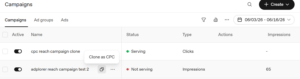
One cool feature we noticed for camapaign management is the ability to clone reach campaigns into cpc campaigns, allowing traffic managers to test targeting with reach campaigns and then convert to a click campaign just a few clicks.
3. Bidding Mechanics for Chat GPT Ads CPC Campaigns
When running Clicks campaigns, understanding the auction landscape is vital for sucessfull ad delivery.
- Setting the Maximum CPC Bid: Advertisers explicitly set a Maximum CPC Bid within the ad group settings. This represents the absolute highest dollar value you are willing to pay for a single user click.
- The Baseline Competitiveness: The interface provides a recommended starting bid baseline (e.g., $3.50 USD). A built-in bid strength gauge gives real-time feedback (such as “Strong Delivery — Your bid is likely competitive for this ad group”), indicating that early AI auctions favor a higher entry point than legacy ad networks.
4. Supported Creative Formats: Native Chat Placement
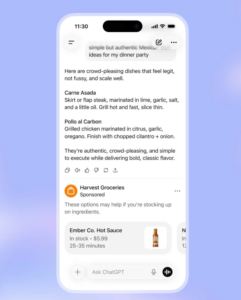
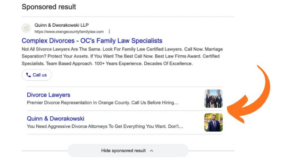
When building your creative assets, it is important to understand where and how your ads will be physically presented to users. ChatGPT ads are displayed natively directly within the conversational chat screen interface, appearing as an inline sponsored response or a visual card following a user’s prompt.
- Image Assets Supported: The platform currently supports standard static image uploads (PNG or JPG format) paired alongside your customizable headline and description. For optimal placement and visual balance within the chat interface, the system recommends a square image ratio (at least 256 × 256 pixels).
- No Video Support (Yet): Unlike mature social media feeds, video files are not currently supported within the chat interface. Your messaging must rely entirely on a clear, high-quality static image and punchy text to disrupt the conversational flow and capture user attention.

5. How Targeting Works: Context Hints vs. Exact Matching
Unlike traditional search engine marketing or social media platforms that rely heavily on complex audience profiling, tracking cookies, or rigid keyword match types, ChatGPT targeting leans into live, conversational context.
Context Hints
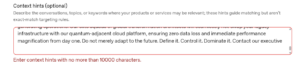
Instead of bidding on exact keywords, advertisers input have the option to provide Context Hints into the system. These are descriptions, topics, keywords, or sample user queries that describe where your products or services are relevant. Note that this is optional, so presumably if no context hints are provided then the system will simply look at the destination url and determine on its own what you and the advertiser are looking for.
Important Notes: These hints act as conceptual guidance for the AI to understand the context of your business, but they do not function as exact-match targeting rules. The platform uses these hints to dynamically match your ad to highly relevant AI conversations.
Keep in mind that the only known limitation to what can be used as a context hint is that it must be text based. Context hints are limited in length to 10,000 characters.
Conversion Tracking
To measure success, advertisers can build custom conversion events directly within the dashboard (e.g., Appointment Scheduled, Lead Created, Order Created, or Page Viewed), which can be tied to a specific data source to track concrete local ROI.
6. The Analytics Blindspot: The “Vague Targeting” Problem
While the conversational context engine is innovative, it currently introduces a significant optimization challenge for metrics-driven advertisers: extremely limited direct performance feedback.
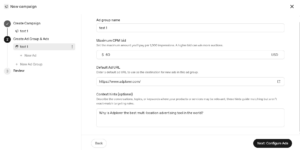
Because Context Hints are blended together by the AI algorithm rather than treated as independent parameters, the reporting interface treats them as a collective unit.
The Optimization Dilemma: If you provide five different contextual hints within an ad group, the platform will deliver your ads, but it will not provide data showing which specific hints successfully guided campaign productivity and which did not.
Without specific attribute-level breakdown (e.g., knowing whether “franchise marketing software” performed better than “multi-location local ads”), local advertisers are left operating in a reporting silo. For now, the only workaround to determine true productivity is isolating your experiments—creating completely separate ad groups or campaigns for each distinct hint to manually measure performance swings.
It’s also important to note that since context hints are optional, destination url quality is always a factor with how ChatGPT will determine where to place the ads. So urls and different landing pages will need to be tested independently for the most precise targeting data.
7. Setting Campaign Budgets: Daily vs. Total Spend
ChatGPT Ads Manager grants advertisers flexible, granular control over how funding is allocated—an important asset for multi-location campaigns that require tight spend parameters.
- Daily Budget (Paced Allocations): This dictates the target amount you intend to spend on average each day. The platform enforces a rigid $25.00 USD minimum daily budget requirement when setting up standard campaigns. This budget is calculated as an average weekly allocation, allowing the algorithm minor flexibility to maximize delivery on days with higher conversation volume.
- Total Spend (Lifetime Budgets): Advertisers can switch from a daily pace to an absolute total budget cap. This sets a hard structural ceiling on the campaign level. Once the campaign hits your maximum set total cap, the delivery engine automatically halts your ads.
- Mid-Flight Flexibility: The interface features a modular edit window allowing local marketers to alter pacing seamlessly, switching active campaigns between total limits and daily averages mid-campaign as local demands change.
8. Streamlining Scale: Bulk Upload & Management Features
For local marketing agencies and enterprise brands managing dozens or hundreds of distinct operational fronts, building campaigns ad-by-ad is highly inefficient. OpenAI bypasses this scaling bottleneck with robust bulk editing infrastructure:
- CSV Schema Templates: Rather than clicking through the standard guided workflow for every single location, advertisers can click Upload Bulk directly from the main “Create” workspace menu. By downloading the system’s spreadsheet template, you can map out entire multi-location hierarchies—including Campaigns, localized Ad Groups, Context Hints, and individualized creative variables—inside a single master document.
- Direct UI Bulk Editing: If your localized assets are already active inside the system, you do not have to export and re-upload files to make adjustments. You can select multiple checkboxes in the Ads Manager main table grid to perform major updates across campaigns, ad groups, and ads simultaneously. This is ideal for instantly raising Maximum CPC bids across an entire region or adjusting target location URLs in mass chunks.
9. Strategic Opportunities & Limitations for Local Brands
For franchise networks and multi-location service brands, ChatGPT ads present a fresh canvas—but navigating them requires a specific operational blueprint.
The Opportunities
- Local Geo-Targeting: Campaigns can be targeted by geographic location (such as specific regional bounds or entire countries), ensuring that your ads only populate in chat streams for users in relevant territories.
- Multi-Ad and Creative Asset Testing: The platform allows you to create multiple ad variations within a single ad group. Local marketers can clone and duplicate ads to swap out unique names, headlines, text descriptions, and destination URLs to find the highest-performing combinations.
The Limitations
- No Agency Accounts (Yet): Multi-location brands cannot currently manage all locations under a single overarching enterprise agency dashboard. Each individual advertiser or location must set up its own unique business account and independently clear the validation process before ads can serve.
- Minimum Budget Aggregation: Because of the strict $25.00 minimum daily budget per campaign, deploying individual campaigns across a vast footprint of locations requires substantial baseline ad spend allocations that must be planned for in advance.
10. Pricing Reality Check: What Benchmarks Can We Expect for Chat GPT Ad Costs?
Because the self-serve ad system is a relatively new marketplace, local businesses are naturally wondering what to expect in terms of actual costs. Because auction density changes dynamically based on the exact topic being discussed, absolute pricing guarantees are hard to come by. However, early data from introductory market pilots gives us clear baseline assumptions:
- Cost-Per-Click (CPC) Assumed Range: Real-world metrics from initial performance marketing rollouts indicate that average click costs hover between $3.00 to $5.00 USD per click.
- Cost-Per-Thousand Impressions (CPM) Observed Range: While OpenAI launched with a maximum structural ceiling of $60.00 CPM, market volume expansion quickly compressed actual clearing rates down to $25.00 to $60.00 USD per 1,000 impressions depending on the vertical. (Source: https://www.webfx.com/blog/ai/chatgpt-ads-cost/)
The Local Market Volatility Factor
Multi-location advertisers must approach these figures with a heavy dose of realism. Conversational AI ad pricing functions exactly like traditional search systems: highly competitive, premium local markets will face drastic pricing fluctuations.
An ad mapping to a context hint for an urgent local service (e.g., “emergency plumber in Atlanta”) will naturally command a far higher market clearing rate than a broader informational topic. Local brands must treat current metrics as temporary benchmarks and prepare to adjust their bidding dynamically location by location.
11. Overall Strategy: Where AI Ads Fit in the Funnel
To win with ChatGPT ads, franchise and multi-location brands must understand when and where consumers interact with conversational AI. Users do not use ChatGPT like a standard search engine index; they turn to it to solve problems, compare options, structure plans, and synthesize complex ideas.
Consequently, ChatGPT ads sit uniquely in the Mid-to-Low Funnel (Consideration and High-Intent Evaluation). It bridges the gap between passive awareness and the final transactional click.
Use Case 1: The Home Services Franchise (High-Intent Problem Solving)
- The Scenario: A homeowner is chatting with AI to diagnose a home issue, using prompts like, “My AC unit is leaking water outside and blowing warm air, what could be the issue?” or “How often should I clean my gutters?”
- The Strategy: A national home services franchise can apply local geo-targeting paired with context hints tailored around troubleshooting, appliance maintenance, and system failures. When the AI finishes providing a technical breakdown of why the unit might be failing, the local franchise’s ad seamlessly appears as the immediate local solution: “Need a pro? Schedule an inspection with [Local Brand] in Atlanta today.”
Use Case 2: The Multi-Location Restaurant Chain (Contextual & Experiential Consideration)
- The Scenario: A user is asking for itinerary planning or group hosting advice, such as, “Plan a 3-day family weekend trip to Chicago” or “What are good catering options for an office party of 30 people?”
- The Strategy: A restaurant chain can leverage these contextual research phases. When ChatGPT outputs the requested travel itinerary or catering checklist, a localized ad card appears presenting a concrete dining or catering option matching that exact itinerary location. By showing a static image of a popular catering platter or seasonal dish right at the moment of group planning, the brand effectively inserts itself into the consideration loop before the consumer ever opens a traditional map or review app.
Conclusion:
ChatGPT ads represent a key step toward native AI monetization. While the vague targeting loop and current lack of centralized agency management mean multi-location deployment requires manual operational heavy lifting up-front, the opportunity to get ahead of the competition in a less crowded, high-intent environment is very hard to ignore..


