




Closing the Local Loop: The Case for Centralizing Data Across Your Franchise Network
For franchise brands and multi-location businesses, local marketing is a constant tug-of-war of priorities between maintaining global or national corporate consistency and capturing hyper-local relevance. Historically, franchise brands have managed local presence in house or via agency partners in silos: one team runs national or local paid search, another handles social media ads, and individual store managers or a third-party agency update local directory listings.
We believe this fragmented model is no longer viable.
To win in modern local search, multi-location brands must transition from siloed execution to unified data orchestration. True optimization occurs when paid ads, organic search, social media, and reputation data are consolidated into a centralized ecosystem.
When your franchise brand’s marketing channels act as distinct, isolated pillars, your brand misses the valuable cross-channel signals that drive smarter budget allocation and superior campaign performance. Centralizing your franchise brand’s local advertising and listing data is the only way to gain the deep, actionable insights necessary to outpace the competition.
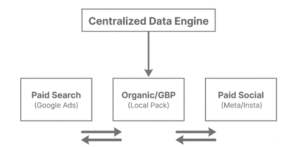
The Interconnected Local Loop: How Channels Feed Each Other
In a siloed environment, a paid search specialist analyzes Google Ads metrics, while a social media manager tracks Meta engagement. In reality, the customer journey is highly fluid. When multi-channel data is centralized, these touchpoints begin to inform and strengthen one another.
1. The GBP-to-Paid-Search Lifeline
When a franchise opens a new territory, the local franchisee faces an immediate hurdle: they have no local organic authority. A brand-new Google Business Profile (GBP) starts with zero reviews and zero historical user signals, making it nearly invisible in competitive local map packs and LLMs..
However, Google’s local ranking algorithm relies heavily on prominence and trust. Data analyzed by local SEO platforms indicates that consistent review growth—such as generating a steady cadence of fresh user feedback—signals active profile management to Google, accelerating the location’s organic GBP authority and local pack rankings.
Yext research shows that multi-location brands that actively manage and synchronize their local information across an extended publisher network experience up to 186% more clicks from Google compared to those with fragmented or unmanaged profiles. Furthermore businesses maintaining a 4 to 5-star rating rank 9% higher in Google’s Local Pack than those with 2 to 3 stars.
For a new franchisee building their presence from scratch, local paid search ads act as an indispensable lifeline during this grand opening period.
By launching localized Google Search and if applicable, Local Services Ads (LSAs), the new location bypasses the organic waiting period to capture high-intent leads immediately. These paid leads translate into completed jobs, which are then leveraged to generate the location’s first wave of customer reviews. This rapid influx of fresh feedback establishes immediate local trust and starts driving the organic flywheel.
2. Using Meta Insights to Fund Bottom-Funnel Google Campaigns
Similarly, top-of-funnel paid social data shouldn’t live in a vacuum. A franchise brand running discovery or promotional campaigns on Meta gathers incredibly rich demographic, geographic, and creative performance data.
If a specific territory or demographic slice shows an exceptionally high click-through rate (CTR) on Meta for a particular service, that interest may represent active local demand.
By centralizing this data, multi-location marketers can dynamically shift budgets, allocating more funds to high-intent Google Search campaigns in those exact postal codes or radiuses to capture users who saw the social ad and are now actively searching for the service. Because a unified data system allows you to track these cross-channel paths, you can maximize return on ad spend (ROAS) rather than guessing which channel drove the final click.
Case Study: The Multi-Channel Seasonality Playbook
To see this interconnected ecosystem in action, let’s look at a concrete example: a multi-location residential landscaping franchise executing a spring cleanup promotion.
The Scenario
The landscaping franchise launches a seasonal promotion on Meta: “Get your yard ready for spring! Use code SPRING15 for 15% off full-service yard cleanups and mulching.”
While the Meta campaign successfully generates awareness and interest, it also alerts local competitors. In the highly competitive landscaping sector, rival companies will bid heavily on your brand terms or broad keywords like “yard cleanup near me” to hijack the demand you generated.
The Unified Multi-Channel Execution
Instead of hoping the Meta ad does all the work, a centralized data strategy coordinates the response across paid search and organic local listings:
- Paid Search (Brand Defense & Conversion): The centralized marketing engine enables a matching Google Search campaign. When users search for your franchise name or “spring yard cleanup specials,” they are met with a paid search ad explicitly highlighting the SPRING15 promotion. This defends your brand space from competitors and guarantees a frictionless path to conversion for users moving from social discovery to search intent.
- Google Business Profile (Organic Local Pack): At the same time, because GBP signals account for a massive share of the local pack ranking criteria—as noted in Whitespark’s Local Search Ranking Factors study—each franchisee’s local listing must be optimized to close the loop.
The marketing team updates the local profiles in three critical ways:
- Service List Alignment: The “Yard Cleanup” and “Mulching” services are explicitly added to each local profile’s services menu, ensuring the business ranks for those non-branded seasonal searches.
- Visual Proof: High-quality, geo-tagged photos of fresh mulch beds and pristine spring yards are uploaded directly to the GBP. Bright, relevant imagery is highly persuasive; Google’s own business data shows that profiles featuring photos receive significantly more requests for driving directions and clicks through to the website than those without.
- Local Google Posts: The franchise publishes localized “Google Posts” on each GBP page showcasing the SPRING15 discount, reinforcing the offer directly within the search results before a user even clicks through to the website.
By executing this coordinated playbook, the brand ensures that the demand created on Meta is successfully captured on Google, while the updated organic business profiles dominate the local map pack.
The Strategic Imperative of Centralized Data
Multi-location marketing is inherently complex. Fragmented data leads to fragmented messaging, wasted ad spend, and missed revenue.
When you centralize your local advertising and presence management data, you unlock the ability to make rapid, data-backed decisions. You can see precisely how a lift in review velocity impacts your cost-per-click on Google Ads, or how a localized social promotion drives physical foot traffic and phone calls.
In modern local marketing, the brands that win are not those with the biggest budgets, but those with the smartest, most connected data. By breaking down the walls between paid, organic, and reputation management, franchise networks can deliver a highly relevant, consistent local experience that drives sustainable growth across every single location.


